Eleven Principles

Introduction to the Principles

The 11 Sri Lankan Bankers Association Sustainable Banking Principles (SLBA-SBP) have been developed under the leadership of the SLBA in 2015 and were signed by 18 Sri Lankan Banks on November 5, 2015.

The Principles are based on leading international sustainable finance standards, and tailored to the Sri Lankan context and development needs. Moreover, they detail the broader, related requirements of CBSL for the banking sector.

The Principles are in line with the commitment of the Sri Lankan banking sector to contribute to sustainable economic growth. Banks can foster positive economic impacts whilst protecting the communities and environments in which they operate.

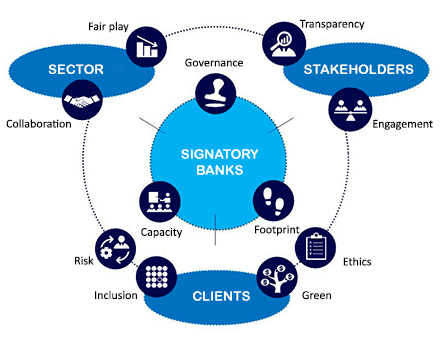
The SLBA-SBP comprise 11 core subjects that environmentally and socially responsible financial institutions should address. Implementers of the principles should evaluate their actions in each of the core subjects, to identify what they are doing in their current practices, and to set priorities for improvements. Broadly, the SLBA-SBP can be divided into 4 different categories. These are principles that concern:

  1. Matters internal to the signatory Banks (3 principles)
  2. The Banks' relationship with their stakeholders (2)
  3. The banks' product and service offerings and how they conduct business (4)
  4. The banking sector itself (2)

Signatory banks are supposed to start with the implementation of the SBP upon publication of this Guide at the latest (December 2018). It is expected that the full implementation of the Principles would not take longer than 2 years.

The 11 Principles

Figure 1: Principles categories

Coherence To CBSL Approach

CBSL, as a member of the Sustainable Banking Network, is instituting frameworks for sustainable finance with the Sustainable Finance Road Map. As part of this, the SLBA has collaboratively worked with the CBSL in developing the Sustainable Banking Initiative (SLBA SBI). The SBI also responds to the GOSL's Vision 2025 in providing the hard and soft frameworks for financial access and inclusivity with enhanced brand value associated with sustainable finance.

CBSL explicitly requested the SL banking sector to “Develop a set of common corporate governance principles for financial institutions to facilitate the implementation of (the CBSL) sustainable finance Road Map”. The SLBA-SBP are concrete answers to this request.

Coherence to Sustainable Development Goals

Finally, both CBSL approach as well as SLBI-SBP support the implementation of the Sustainable Development Goals. The present guide makes reference to the most relevant goals wherever meaningful, in order to demonstrate signatory Banks contribution to SDG.

The Principles

  • Principle 1

    Principle 1 - Our Business Activities : Environmental and Social Risk Management

    "We will integrate environmental and social considerations into decision-making processes relating to our Business Activities to avoid, minimize or offset negative impacts."

  • Principle 2

    Principle 2 : Our Business Operations: Environmental and Social Footprint

    "We will avoid, minimize or offset the negative impacts of our Business Operations on the environment and local communities in which we operate and, where possible, promote positive impacts."

Principle 1 - Our Business Activities : Environmental and Social Risk Management

"We will integrate environmental and social considerations into decision-making processes relating to our Business Activities to avoid, minimize or offset negative impacts."

What Does This Principle Mean?

Business Activities in this context are “the provision of financial products and services to clients including, but not limited to: corporate finance, investment banking (corporate advisory, structured lending and capital, trading), equity investments, project finance, project finance advisory, structured commodity finance, small and medium business lending, trade and leasing, and other forms of direct lending”.

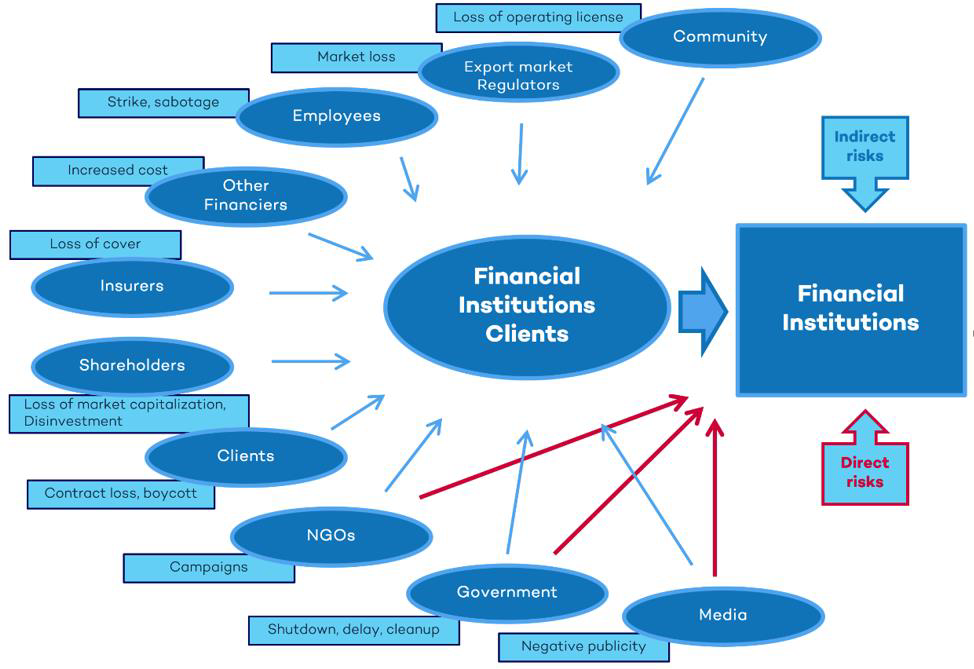
Environmental and social (E&S) risks related to Banks clients can translate into direct monetary losses for a Bank. Banks thus have not only an ethical but also an economic incentive to fully understand their clients’ E&S performance, thereby strengthening their own Business Activities.

Environmental and social risks related to Banks clients business activities can include:


  • Direct operational risks leading to potential financial losses; 
  • Reduced profitability due to higher costs;
  • Substantial clean-up costs;
  • Delayed construction and completion of projects;
  • Penalties/sanctions levied by local authorities;
  • Market loss due to a boycott of clients;
  • Financing risks (lower willingness of financiers to borrow/fund);
  • Reputational risks for both the borrower and potentially the Financing Bank, such as negative headlines or even NGO campaigns (possibly leading to loss of social licence to operate)
  • Strikes of workers


The number of cases in which Banks have either lost money or reputation due to a failure of their client’s to manage their E&S is rising and will certainly continue to rise (increasing accumulation of negative E&S impacts in productive sectors, public that is more aware of E&S risks to them and prepared to act on their concerns, social media networks which allow to organise large scaled protest, fake news damaging banks reputation, legal risks, operational losses, etc..). As such, the involvement of all stakeholders and the “social licence to operate” become more and more important.


Experience globally shows that including a consideration of E&S issues in a financial transaction provides the Bank with a broader understanding of potential impacts, risks and opportunities associated with a Client’s activities, which may not be apparent when merely looking at the financials.

Implementing Principle

To increase more sustainable lending and to manage exposure to risks arising from a client’s failure to adequately manage their E&S impacts and risks, a Bank can develop, implement and maintain policies and procedures, to guide the consideration of E&S risks through their credit decision making processes.

Typically, this is referred to as an Environmental & Social Management System (ESMS) and ultimately should be integrated into existing credit policies, procedures and risk compliance systems. It is suggested that this ESMS encompasses all new transactions financed by signatory banks when implementing this principle.

Such an ESMS typically has the following components, and these have to be developed when implementing this principle:


  1. Environmental & Social Policy Statement (CBSL requirement) as part of a Sustainable Banking Policy Statement or standalone: The E&S Policy statement is a commitment of the Bank to promote environmental and social sustainability in its Business Activities, approved by top-management and communicated to stakeholders. The policy should be in line with financial products and services offered and with priority sectors; at minimum a strict review and potential decline of clients or engagements that do not comply with local E&S laws and regulations. Ideally it refers to international good practices as articulated in the IFC Performance Standards, the ADB Environmental and Social Assessment Guidelines or similar.
  2. Exclusion List: Adherence to a list of activities excluded from financing (see Principle 6);
  3. ESMS Procedures Manual (CBSL requirement): The Manual is the core of the ESMS. It defines oversight mechanisms, system ownership, responsibilities and procedures necessary to achieve the E&S Policy commitment. It signposts integration of key process steps into the credit and compliance and risk management procedures.


     Toolbox Section 2 provides detailed Guidance on this issue.

The E&S procedures include:

  1. E&S screening
  2. E&S risk categorization into high/ medium / low risk
  3. E&S due diligence
  4. Legal provisions to cover E&S requirements in financing agreements
  5. Client E&S performance reporting
  6. Portfolio level E&S risk monitoring and management
  7. Grievance mechanism (external/internal)
  8. System compliance

Figure 4: ESMS process steps in relation to the respective credit process steps


Supporting documentation that a Bank shall develop to assist those tasked with overseeing and implementing the ESMS. Samples can be found here in the Toolbox.

  • Typical E&S responsibilities for the different roles across the ESMS e.g. responsibilities of E&S coordinator, relationship managers, credit analysts with respect to the ESMS, credit approval authorities, board committees; (See Principle 5: E&S Governance)
  • Position/policy statements on sectors with a high E&S risk profile that clearly articulate how the Bank undertakes financing in those sectors e.g. forestry, mining, tobacco, renewable energy (Sample from Standard Chartered)
  • Position/policy statements on critical environmental and social issues e.g. human rights, climate change, water that clearly articulate the Bank’s position on such matters
  • E&S risk categorisation and screening model; (Toolbox E&S Risk Management)
  • Register of national E&S laws imposed on sectors typically financed, including key permits, licences etc.
  • E&S questionnaires to assist analysts to assess environmental and social risks associated with the client’s activities; (Toolbox E&S Risk Management)
  • E&S due diligence report template, including environmental and social action plan template (Toolbox E&S Risk Management)
  • E&S monitoring template for post-disbursement monitoring of each client.
  • Example Terms of Reference for commissioning external E&S specialists; (Toolbox E&S Risk Management)
  • List of pool of qualified experts;


For project related facilities (corporate finance with a concrete project purpose as well as project finance) a transaction related methodology is required. Assuming that larger projects tend to have higher E&S risks, especially for sector that are classified as high risk, it is suggested that the following thresholds are to be applied:


Threshold (total project value) E&S management minimum requirements 
<3 Mio. US$ Screening against exclusion list, E&S categorisation, standard E&S legal building blocks
Higher than 3 Mio. US$ total project value and tenure > 1 year Robust E&S Management System (ESMS) based on good international practices (DEG ESMS KPIs)
> 10 Mio. US$ External E&S due diligence category A or (B and not requiring an EIA according to local law), ideally compliance with international standards (IFC, ADB, Equator Principles, or similar)

For other facilities (e.g. general short and long term corporate financing, SME finance, revolving working capital facilities, trade finance) a client related methodology is required, involving a client screening to better understand the impact of the operations they have (exclusion list, E&S management system, specific risk flags) as well as potentially adding value to clients business, realising positive impact, sharing knowledge.

Key staff involved with the ESMS implementation in the Banks are in particular Head of Risk/Credit Risk/Corporate Banking/Credit Administration, Relationship Managers, Credit Analysts, E&S Manager, E&S Officer/Coordinator as well as internal training functions responsible to further train Bank staff and multiple exposures to the training within the participating banks.

&nbsp

Learn more about this in

E-Learning Module II: E&S Risk Management - How to do it

4 also referred to as E&S risk analysis, E&S risk assessment and not to be confused with and Environmental and Social Impact Assessment which is study undertaken by a client/project proponent, usually as a regulatory requirement) commensurate with level of E&S risk exposure, findings and recommendations to be included in the credit proposal
Key Performance Indicators

Banks implementing this principle are supposed to achieve the KPIs as suggested below and report on the progress made.

  • KfW/DEG Key Performance Indicators for setting up an ESMS
  • Regular consulting of SLBA-SBI toolbox or equivalent
  • Number of and value of transactions by financing type that have been categorised for E&S risk (by no and percentage; and by amount and percentage of total) for new facilities
  • Number of and value of transactions by financing type that have been categorised for E&S risk (by no and percentage; and by amount and percentage of total) for facilities being renewed
  • Breakdown of number of transactions and total value in Category A (high risk), Category B (medium risk) and Category C (low risk).

Link to Relevant Good Practice and Global Initiatives

Name of Document Why is it important Source
Environmental and Social Management System (ESMS) Implementation Handbook For banking clients who wish to implement a management system in line with good international practices.  

Visit Website

ESMS Self-Assessment and Improvement Guide (IFC) The ESMS Self-Assessment and Improvement Guide contain a questionnaire, maturity matrix and improvement tips to help a client company measure the maturity of its management system and develop a plan for improvement.  

Download Resource

ESMS Toolkit (IFC) Provides tools - checklists, templates, and forms - to help banking clients implement their ESMS improvement plan.

Download Resource

First for sustainability (IFC) Further references, additional guidance, and good practice materials (for banks)  

Visit Website

ADB Environmental Assessment Guidelines These guidelines describe how to fulfil the requirements outlined in ADB's Environment Policy and the Operations Manual on Environmental Considerations in ADB Operations. Information on ADB's policies and procedures for conducting and reporting on the environmental assessment is also provided for all types of projects.  

Visit Website

GRI G4 Financial Sector Guidelines

provides additional guidance when reporting on procedures for assessing and screening environmental and social risks in business lines (page 28) and processes for monitoring clients’ implementation of and compliance with environmental and social requirements included in agreements or transactions (page 29).

While the G4 has been replaced, the related sector guidelines remain valid.


Download Resource

FMO - Microfinance and SME Sustainability Guidance E-Learning Tool FMO has developed two tools to support its clients in terms of environmental, social and governance (ESG) risk management.

Visit Website

CDC ESG toolkit for fund managers Free-to-use toolkit aimed at private equity fund managers in emerging markets. The Toolkit aims to be both a practical building block for the development of a customised ESG management system, and an easy-to-use reference guide for assessing and managing ESG risks, impacts and opportunities.  

Visit Website


Learn more about this in

E-Learning Module II: E&S Risk Management - How to do it


Principle 2 : Our Business Operations: Environmental and Social Footprint

"We will avoid, minimize or offset the negative impacts of our Business Operations on the environment and local communities in which we operate and, where possible, promote positive impacts."

What Does This Principle Mean?

Banks will consider and manage appropriately the direct impacts on the environment and society arising from its own Business Operations (E&S Footprint).

Business Operations in this context are “the undertakings of employees and the physical human capital, assets and infrastructure (e.g. offices, branches, equipment) that a Bank engages in the course of facilitating its Business Activities.”

Through this the Bank is playing its part in contributing to the more efficient use of resources associated with the operation of a Bank as well as ensuring the health, safety and welfare of its employees and the public.   

The principle further relates to Corporate Social Responsibility initiatives of Banks as well as environmental and social procurement policies.

Implementing Principle

A Bank will need to find its ways to avoid, minimise or offset negative impacts whilst implementing new means to achieve positive gains. This includes:


1

Development of an E&S footprint management programme with facilities management, which addresses:

  •  Climate change and greenhouse gas emissions reduction: A Bank can support energy efficiencies by promoting or utilising renewable power generation, reducing business travel and commuting, and adopting green building standards and practices for operating and maintaining facilities and buildings.
  • Water Efficiency: A Bank should promote the efficient use of water and seek to sustainably manage its use of water resources (i.e. reduce, reuse and recycle) that may include improved maintenance of infrastructure and recycling wastewater for grounds management.
  • Waste Management: A Bank should improve waste management by eliminating, reducing, and recycling product and paper waste; using not only less material (e.g. less paper, less packaging, etc.) but also implementing more efficient waste management systems to reduce the amount of waste produced and adopt safe mechanisms to dispose electronic waste.
  • Environmentally friendly facilities construction and management: A Bank should strive to improve the energy efficiency of its existing facilities and, where new facilities are constructed, incorporate energy efficiency measures or renewable energies.
  • Health and Safety: A Bank should also ensure appropriate health and safety considerations are taken into account in managing physical operations (e.g. firefighting equipment, first aid services, related trainings) and, where possible, provide positive improvements (e.g. disabled facilities etc.).


2

Compliance with applicable labour and social standards for own staff

A Bank should outline the minimum labour and social standards it will apply in managing its own Business Operations consistent with Sri Lankan requirements and international good practice standards.

Labour practices refer to fair treatment of all workers / employees, including those who are sub-contracted rather than being regular employees. Labour practices include hiring and promotion of employees / workers; disciplinary and grievance procedures; transfer and relocation of employees; termination of employment; training and skills development; health, safety and industrial hygiene, and any policy or practice affecting conditions at work.

Labour practices also include recognition of worker organizations and participation in collective bargaining, including tripartite (business – workers – government) consultation to address social issues related to employment as applicable. To implement the related principle with regard to labour practices, in particular, Banks Human Resources Department need to:

  • Fulfil all legal obligations to workers / employees; eliminate discrimination in hiring and dismissals.
  • Avoid contracting with partners, suppliers or sub-contractors who use unfair, exploitative or abusive labour practices.
  • Provide good conditions of work and social protection. Comply with national laws and regulations; provide decent conditions of work in wages, hours of work, weekly rest holidays, health and safety, protection against sexual harassment in the working place, and maternity protection.
  • Assuring gender equality. Inclusion of women in the workplace, diversity, equal pay for work of equal value and addressing the gender pay gap.
  • Support social dialogue. Social dialogue involves negotiations, consultations and information exchanges between employers and employees.
  • Promote and maintain health and safety at work.
  • Encourage human development. Provide skills development and career training opportunities.


3

Development and implementation of a sustainability initiatives as well as a Corporate Social Responsibility Program (CSR)

Banks should demonstrate Corporate Social Responsibility through a well-targeted CSR program, aligned with Sri Lanka’s overall goals for economic and social development or with the needs of communities affected by the Banks investments (CBSL requirement).

This programme should be developed in close cooperation with the Banks stakeholders, in particular affected communities and based on actual needs or strategically aligned to Banks core business rather than on preferences by the project developers or heads of the communities


4

Requiring suppliers and service providers to follow minimum environmental and social standards, respectively selecting suppliers (among others) based on E&S criteria

A Bank should formulate minimum E&S standards as well as relevant contractual standard building blocks for Bank suppliers, contractors (e.g. cleaning or security services), and other third party service providers in the Bank’s Sustainable Banking policy statement and procedures. It needs to be noted that the Government Procurement Policy has covered all local and internationally accepted labour laws and standards.

The Bank should screen, engage and monitor such service providers to ensure they meet these standards. Banks should also specifically practice environmental or social procurement – evaluate suppliers of goods and services on whether they also are environmentally / socially friendly (at least on a random basis). Reporting metrics should include information about the number of suppliers, contractors, and third party service providers assessed and the standards that have been applied.

The procurement practices should be fully in line with the related. The procurement practices should be fully in line with the related requirements of GOSL. Please visit the relevant GOSL website(s).

A more detailed guide on how Banks can manage their E&S footprint can be found here: E&S Footprint Guide


Key Performance Indicators

Continuous improvement year-on-year demonstrated through quantifying and reporting:

1

    E&S footprint

  • Targets as per E&S footprint management program, in particular with regard to energy consumption / water consumption / waste management
  • Optionally: GRI G4 requirements as per page 8 of financial sector supplement

2

    Own social standards

  • Presence of written social standards in line with at least local minimum requirements / Government Procurement Policy
  • 100% compliance with relevant labour and social standards / 0 non conformities in audits performed by local authorities or others
  • Information on numbers grievances received / solved / open
  • Presence of grievance mechanism for own employees and subcontracted workforce
  • Presence of a mechanism to penalise third parties for not following the expected minimum labour standards
  • No. of relevant spot checks carried out
  • Optionally relevant GRI indicators (labour practices, decent work, etc.)

3

    CSR program

  • Presence of a suitable CSR programme including necessary budget and other necessary resources
  • KPI as per CSR program

4

    Third parties

  • E&S standards for third parties developed and signed off by top management
  • E&S standards / legal clauses as part of all new contractual relationships with suppliers
  • Collection of defined monitoring parameters or in the absence of such parameters spot checks at third parties.

Relevant International Standards

Name of Document Why is it important Source
A Guide to Managing Your Bank’s E&S Footprint Detailed description on how to manage the direct Environmental and Social footprint.  

Download Resource

UNEP FI - Guide to Banking & Sustainability High-level, functional overview of what a sustainable bank looks like  

Download Resource

BankTrack tracking Activist NGO tracking the activities of the banking sector and its impact.

Visit Website

The Greenhouse Gas Protocol Initiative Standards and tools for clients to manage their institutional GHG footprint.  

Visit Website


Learn more about this in

E-Learning Module III: A Banks E&S Footprint

Link to Relevant Good Practice and Global Initiatives

Name of Document Why is it important Source
A Guide to Managing Your Bank’s E&S Footprint Detailed description on how to manage the direct Environmental and Social footprint.  

Download Resource

UNEP FI - Guide to Banking & Sustainability High-level, functional overview of what a sustainable bank looks like  

Download Resource

BankTrack tracking Activist NGO tracking the activities of the banking sector and its impact.

Visit Website

The Greenhouse Gas Protocol Initiative Standards and tools for clients to manage their institutional GHG footprint.  

Visit Website


Learn more about this in

E-Learning Module III: A Banks E&S Footprint