Project Level Risk
Section of 8
Introduction
Typical project cycle for a transaction related approach
E&S screening and Exclusion list
E&S Risk Categorization
E&S Due Diligence
Credit committee meeting / credit approval
Contract negotiation
Monitoring
Introduction
The following sub-section of the toolkit describes step by step how E&S risks in a particular investment project could be managed by your bank, respectively are typically managed by other banks (best practices)
The following abbreviations are used:
|
|
|
|
|
Menu |
|
Toolbox-Link |
|
Document Download |
|
External Link |
|
|
|
Typical project cycle for a transaction related approach
Please remember that as per Implementation Guide for the SLBA SBP (Principle 1): for project related facilities (corporate finance with a concrete project purpose as well as project finance) a transaction related methodology is required. The following suggested project cycle relates to this transaction related methodology. Banks following this approach work very much towards the implementation of Principle 11, fair play.
Please also bear in mind that for as per SLBA SBP Implementation Guide (Principle 1) other facilities (e.g. general short and long term corporate financing, SME finance, revolving working capital facilities, trade finance) a client related methodology is required, involving a client screening to better understand the impact of the operations they have. This relates in particular to step 1 of the shown project cycle (i.e. step1 - exclusion list, screening for specific risk flags and the evaluation of their ESMS - see Training Module 2).
Transaction related method:
For a given investment project that is subject to your ESMS, the typical E&S management procedure includes.
- E&S screening including the exclusion list suggested by SLBA-SBI can be found here checking
- E&S risk categorization into high medium low risk
- E&S due diligence, i.e. the verification to which extent the project complies with your bank E&S standards
- Credit review meeting
- Legal provisions to cover E&S requirements in financing agreements
- Client E&S performance reporting monitoring
All these steps need to be carried out at least in parallel, if not integrated into the respective investment process steps:
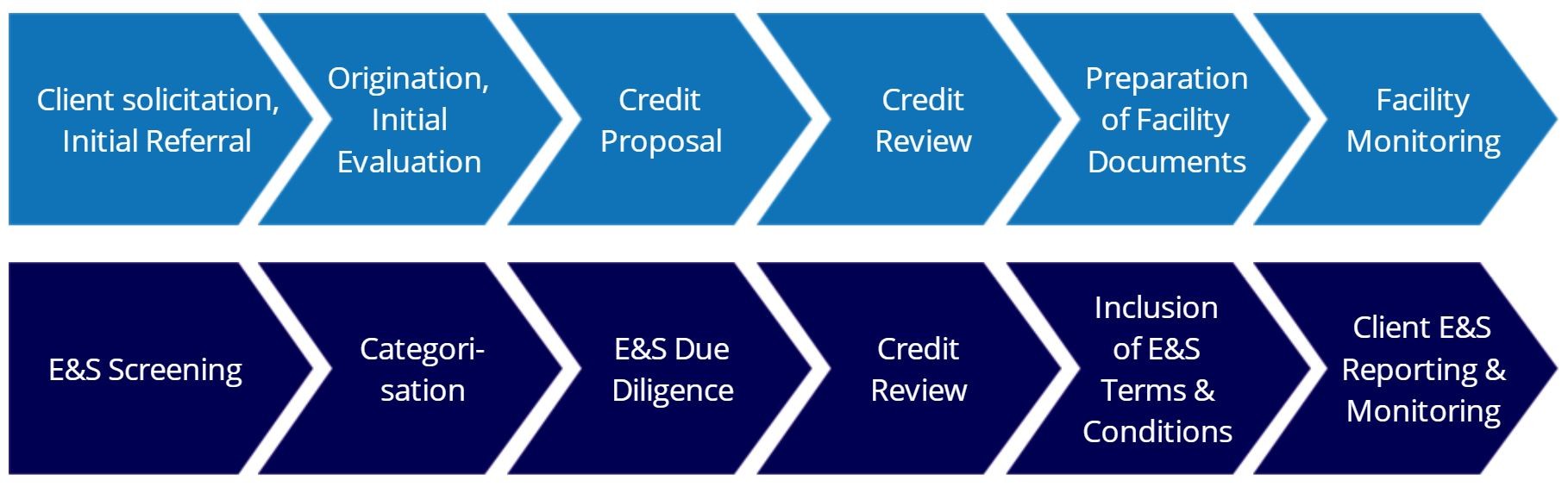
ESMS process steps in relation to the respective credit process steps (from Implementation Guide)
In order to keep the process manageable, the screening may exclude transactions or sectors that are generally low risk (e.g. very small loan size, small-scale housing projects).
E&S screening and Exclusion list
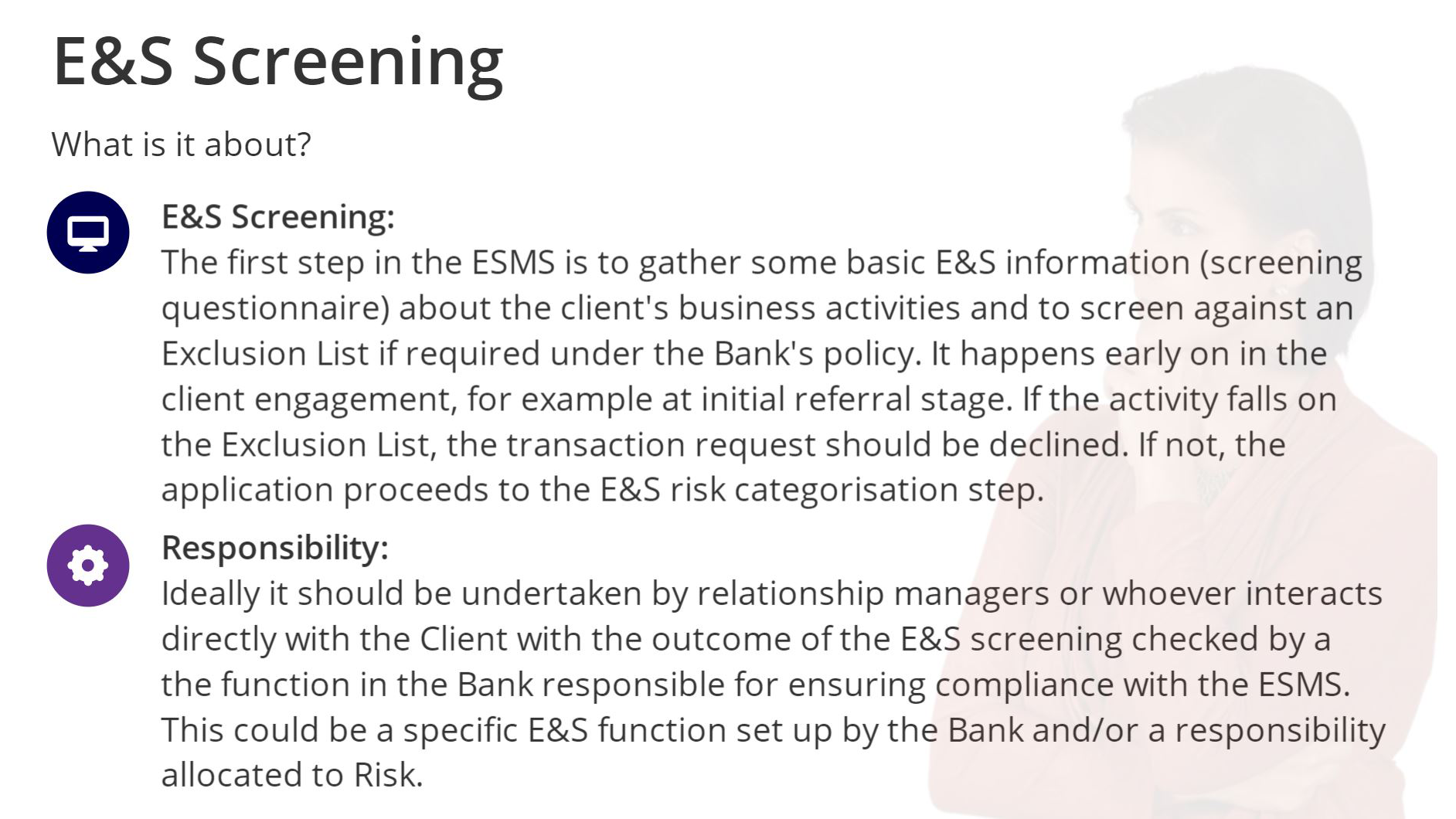
E&S Screening is an exercise in which typically the RMs identify the most likely key E&S aspects of a planned investment, taking into account the company’s particular characteristics including scale, location, sector and supply chain. Screening is typically a desk-based exercise which is done with the help of
- sector guidelines (e.g. CDC Sector Profiles, First for sustainability, ERBD) as well as
- clients questionnaires (e.g. First for sustainability, DEG questionnaire category A, DEG checklist category B, E&S checklist for SMEs
Red flags identified during the E&S screening need to be followed up during the E&S due diligence.
E&S Screening also involves an E&S Legal Check:
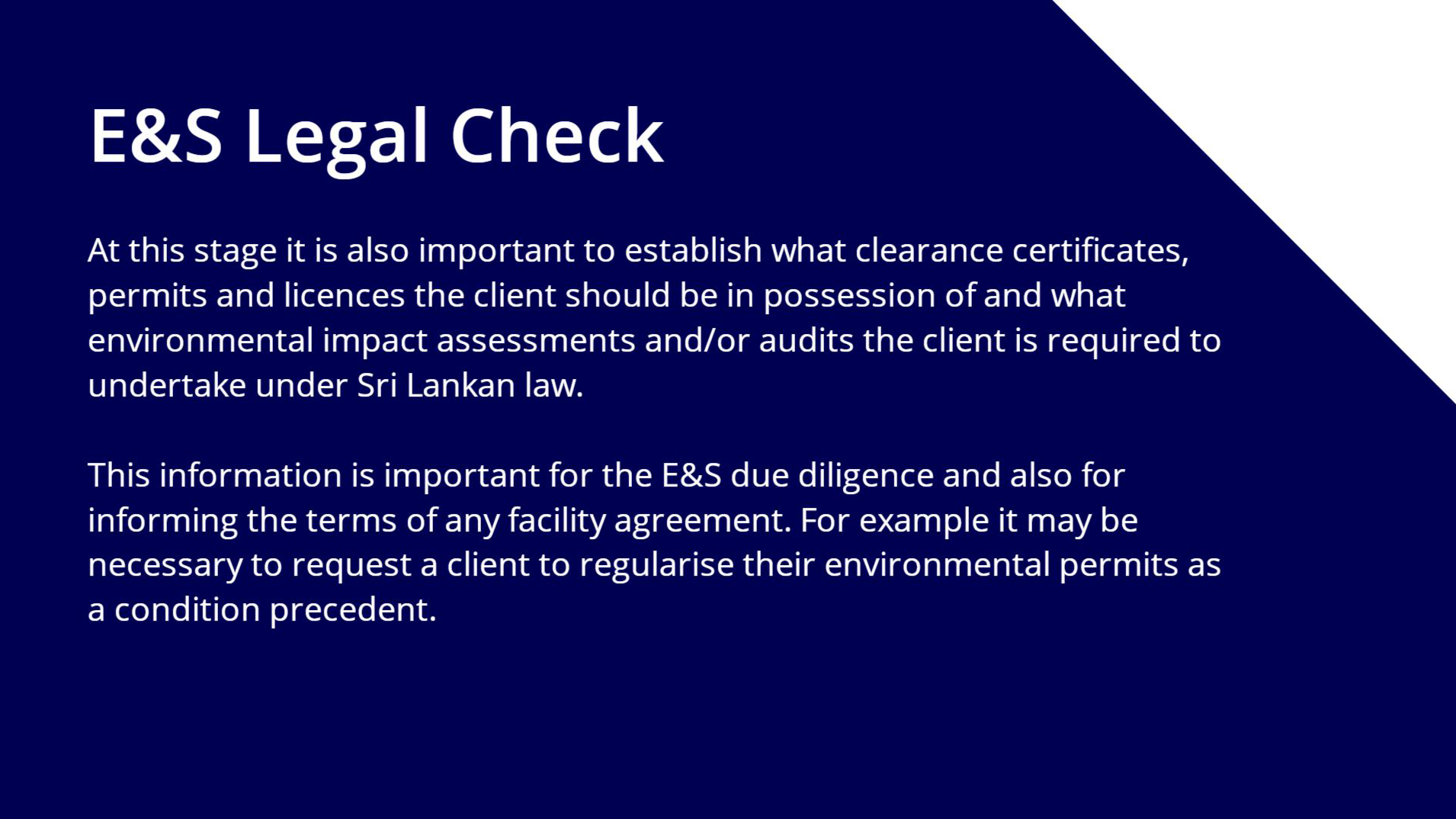
Additionally, and also as part of the E&S Screening, the RM in charge of a particular project has to check whether the project to be financed is on the banks exclusion list (or somewhere close to it). The exclusion list suggested by SLBA-SBI can be found here.
Projects or activities figuring on your exclusion list cannot be financed.
E&S Risk Categorization

It is up to the bank to develop an internal model for their needs but the categorization could be as straightforward as low, moderate and high risk tiers or follow industry standards such as the IFC Performance Standards and the Equator Principles.
Many banks do the following:
This step is usually required for all projects that fall under the ESMS scope (e.g. >1 Mio USD / 1year). The projects shall then be categorised according to their potential environmental and social impacts. There are three risk categories:
High Risk
|
There may be highly significant, negative and or long-term environmental and social impacts, the magnitude of which is difficult to determine at the application stage. Examples of such projects can be found here. |
Medium Risk
|
Environmental and social impacts can be readily identified and standard preventative and or remedial measures can be prescribed. |
Low Risk
|
Environmental and social impacts are expected to be negligible. |

The purpose of the categorisation is not only to signalise its environmental and social relevance, but also to determine the procedures for the next steps in the E&S review procedures (in particular E&S due diligence)
The RM in charge of the planned investment project will usually collect all necessary data from the client to make a categorisation. High-risk industry sector lists and categorization systems developed by multilateral or bilateral financial institutions also provide good preliminary guidance.
The tools typically work on the basis of the following input data (criteria), most of which are usually already available with the project managers handling corporate clients.
Criteria determining the potential environmental risks (environmental category):
- project type (e.g. greenfield, brownfield, projects incorporating privatizations)
- project sector and activities (which cause e. g. consumption of resources, use of hazardous materials, effluents, emissions, wastes, etc.)
- specific location (site and potential impacts of operations on sensitive areas incl. impacts on biodiversity etc.)
- size of the project (large, medium or small scale), as compared to similar projects in the East African region
- Environmental impacts of the supply chain (immediate and important suppliers)
Criteria determining the project’s potential social risks (leading to the social category):
- number of employees
- presence of certain risk groups (e.g. temporary workers, migrants, minors, women, disabled persons) affected communities (e.g. physical or economic displacement, impacts on social and economic infrastructure, community health and safety, vulnerable groups)
- sector (e.g. low wage industries, agriculture, mining, infrastructure projects)
- health and safety risks
For the following process steps, the project should only receive ONE SINGLE category which goes by the category that is higher, i.e. if the environmental category is B and the social category is A, then the overall category is A.
Many banks decide that after the RM has categorised the project, it is the ESC who crosschecks the result (“4 eye principle”). The ESC has the right to override the categorisation proposed by the RM, if he deems it necessary (would need to give a written justification for this).
| What | Description | Source |
| First for Sustainability – categorization assistance | List of typical category A/B/C projects. | |
| EBRD E&S Risk Management toolkit for FIs | The E&S Risk Management Toolkit is a user friendly tool to help FIs to meet the requirements of EBRD’s E&S Risk Management Procedures | |
| EBRD categorization assistance to FIs | EBRD E&S Risk categorization list |
E&S Due Diligence
The objective of E&S due diligence is to systematically:

1
Establish gaps between the client’s E&S performance and standards identified by the Bank in the proceeding step;
2
Identify those performance gaps which present a risk to the Bank
3
Establish the commitment, capacity and track record of the client to manage E&S impacts; and
4
Identify corrective actions to address the Bank’s concerns, in consultation with the client.
An E&S due diligence (ESDD) is also referred to as “E&S risk analysis”, “E&S risk assessment” and must not to be confused with and Environmental and Social Impact Assessment (ESIA) which is study undertaken by a client/project proponent, usually as a regulatory requirement.
The level of ESDD typically has been determined by the projects category.
It is generally true to say that a more extensive analysis is typically required for medium and high-risk transactions. Which may require the expertise of sustainability experts within the bank and/or hiring additional sustainability employees, conducting E&S audits, site visits, or contracting external expertise. The risk analysis usually results in recommendations on potential E&S risk mitigation measures to be agreed upon between banks and its client.
Many banks do the following:

The procedures to be followed after risk categorisation strongly depend on the potential risks identified:
For Category C projects no ESDD is necessary.
For Category B the environmental and social due diligence (ESDD) is usually comparatively simple. A short “internal checklist for category B projects” is considered sufficient to assess potential environmental and social risks. The purpose of this checklist is to rule out that major environmental and social risks are hidden in the project.
If the RM is in a position to fill the checklist by himself, the checklist does not need to be handed over to the client. However, the RM has to assure that all questions are answered properly to his best knowledge. The checklist shall be kept in the files, once the facility is approved, for future references.
If any red flag issues become apparent (one or several statements that are “not confirmed”) the ESC has to be contacted and further investigations may have to be initiated. The main idea is to assure that the client is fully complying with local E&S regulation. If considered necessary by the ESC, an action plan with mitigatory actions leading the client to compliance with your banks E&S requirements has to be formulated.
For category A projects, the banks ESC will be in charge of the ESDD, assisted by the respective RM. If considered necessary, he can ask for the assistance of an external expert.
Most important element of the ESDD is to find out the gaps between the clients current E&S performance and the benchmark performance (very often IFC Performance Standards, respectively your banks E&S requirements, SLBA requirements). The gap analysis with regard to these requirements is considered crucial to ensure that the client is managing E&S risks in accordance with internationally recognized E&S risk management standards.

The gap analysis has to be provided by the client or ideally an external expert for category A projects. As sample for Terms of reference for such an external consultant can be found here. (provided by DEG). It has to lead to the formulation of an E&S Action Plan (ESAP), which describes all the actions necessary to achieve your banks E&S requirements in a given time frame.
Two samples of an ESAP for category A projects (cement plant – health and safety issues / power plant – environmental issues can be found here (ESAP cement plant / ESAP power plant))
The Environmental and Social Due Diligence for category A projects would involve the following steps:
- Asking client to fill your “questionnaire for category A projects”
- Handing over to the client the relevant, sector specific IFC Sector Guidelines and Guidance Notes
- Asking client to prepare a gap analysis between client’s performance and the performance defined in the IFC Performance Standards (if necessary with the help of an external expert).
- Collect and study original ESIA documents or other relevant documents (audit reports, etc)
- Carrying out an internet research on potential risks / potential NGO interest
- Visiting the site (ESC and / or external expert) (Site visit Guide)
- Preparing an action plan (ESAP) if your banks requirements are not yet being met (based on the gap analysis), i.e. mitigation measures (e.g. obtaining regulatory permits, external stakeholder buy-in) for gaps / issues that have been identified in the screening and ESDD stage.
Most challenging steps are usually No 3 and No 7.
In case you benchmark against the IFC Performance Standards, then you may want to get input on the following key questions per Performance Standard:
| Performance Standard | Description | Source |
| 1 | Assessment and Management of Environmental and Social Risks and Impacts | |
| 2 | Labor and Working Conditions | |
| 3 | Resource Efficiency and Pollution Prevention | |
| 4 | Community Health, Safety, and Security | |
| 5 | Land Acquisition and Involuntary Resettlement | |
| 6 | Biodiversity Conservation and Sustainable Management of Living Natural Resources | |
| 7 | Indigenous Peoples | |
| 8 | Cultural Heritage |
Based on the ESDD, the ESC has to prepare an “Environmental and Social Review Summary” report (ESRS) in a pre-described format, containing:
- The findings for each E&S risk issue
- The gaps identified between clients performance and the banks E&S standards (gap analysis)
- the various mitigation measures (ESAP) as well as
- conditions precedent to disbursement (if any).
The ESRS becomes Annex to the project appraisal report.
Credit committee meeting / credit approval
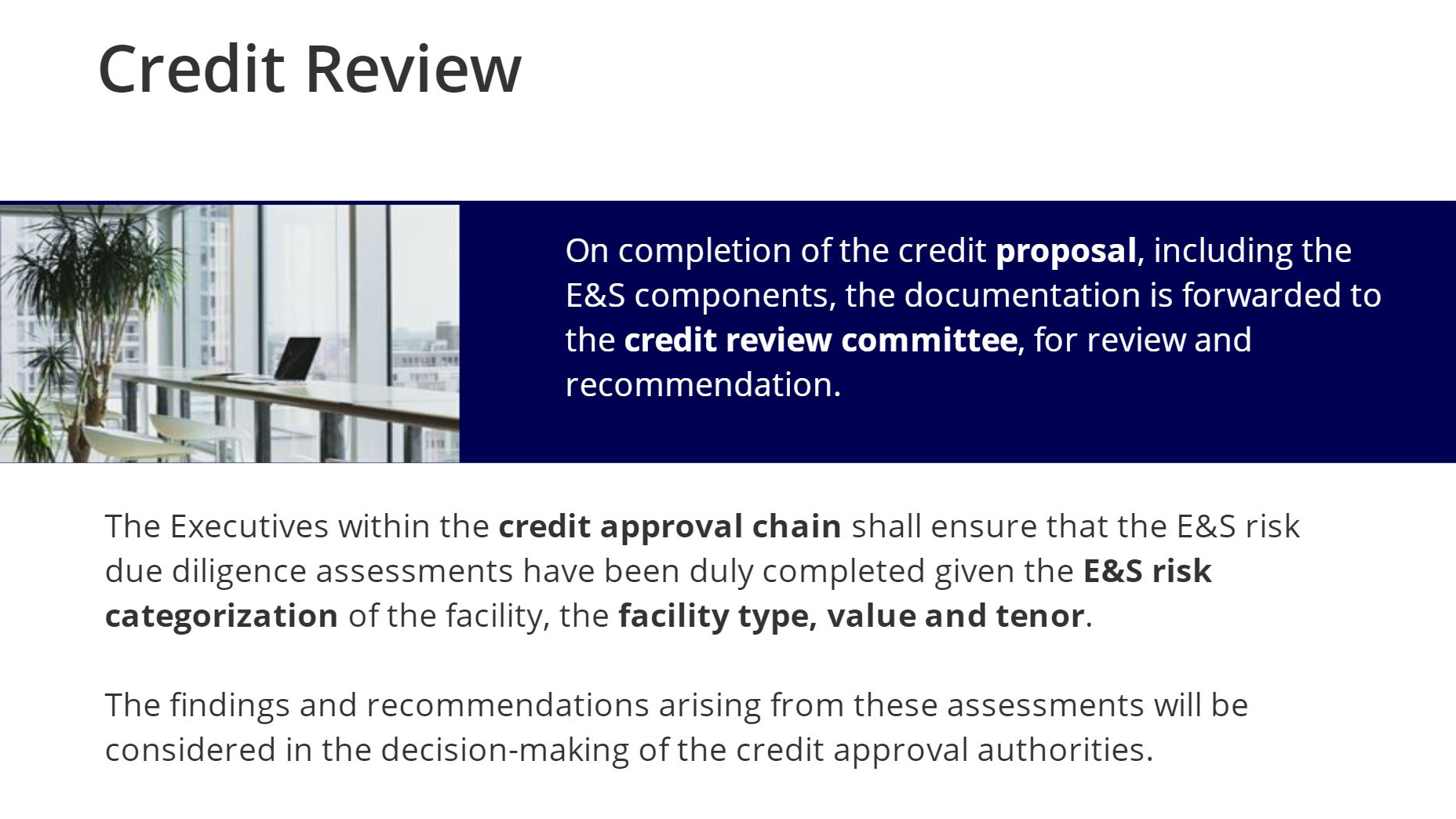
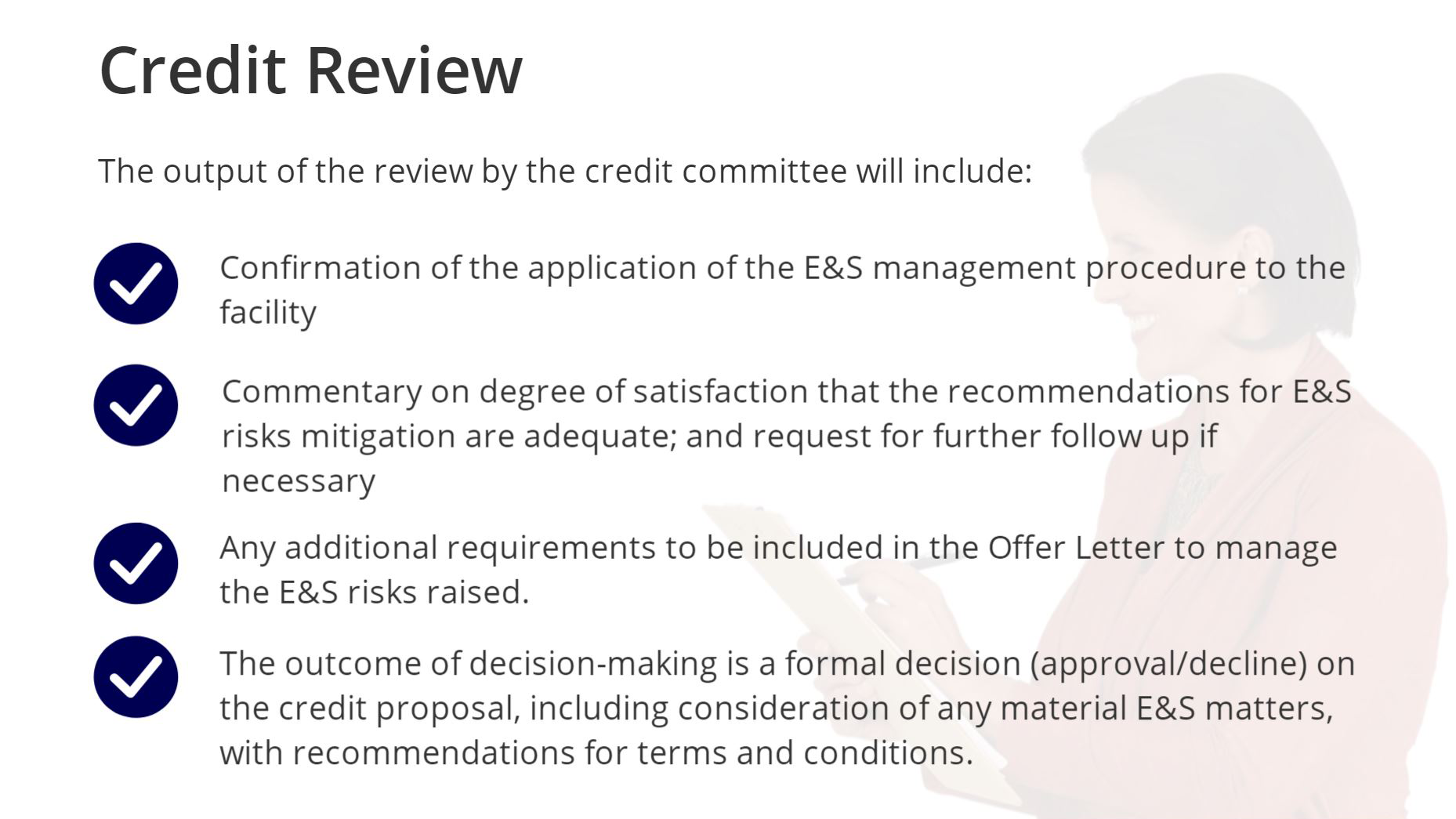
Many banks do the following:
For category B and C projects:
- The project appraisal report has to have a standard clause indicating the expected environmental risks:
- “The project has the Environmental and Social category B C. Related risks are considered to be moderate low”.
- The RM has to assure that this clause is inserted into the appraisal report.
For category A projects:
- The ESC has to add the summary of the Environmental and Social Review Summary (ESRS) (ESRS format) to the main project appraisal report to be submitted to the credit committee and to add the full ESRS as Annex to the appraisal report. The summary primarily informs the decision makers about the clients’ compliance with the local standards, the gap analysis to your banks standards, the associated risks and the company’s management capabilities to cope with the risks. The RM has to assure that the appraisal report is complete.
- The RM has to assure that this clause is inserted into the appraisal report.
Contract negotiation
Contract negotiation starts with the communication of the necessary mitigation measures (ESAP) to the client and/ or the definition of condition precedents for disbursement (if any). Compliance with E&S regulation, as well as the bank’s internal sustainability policies need to be contractually agreed.
Many banks do the following:
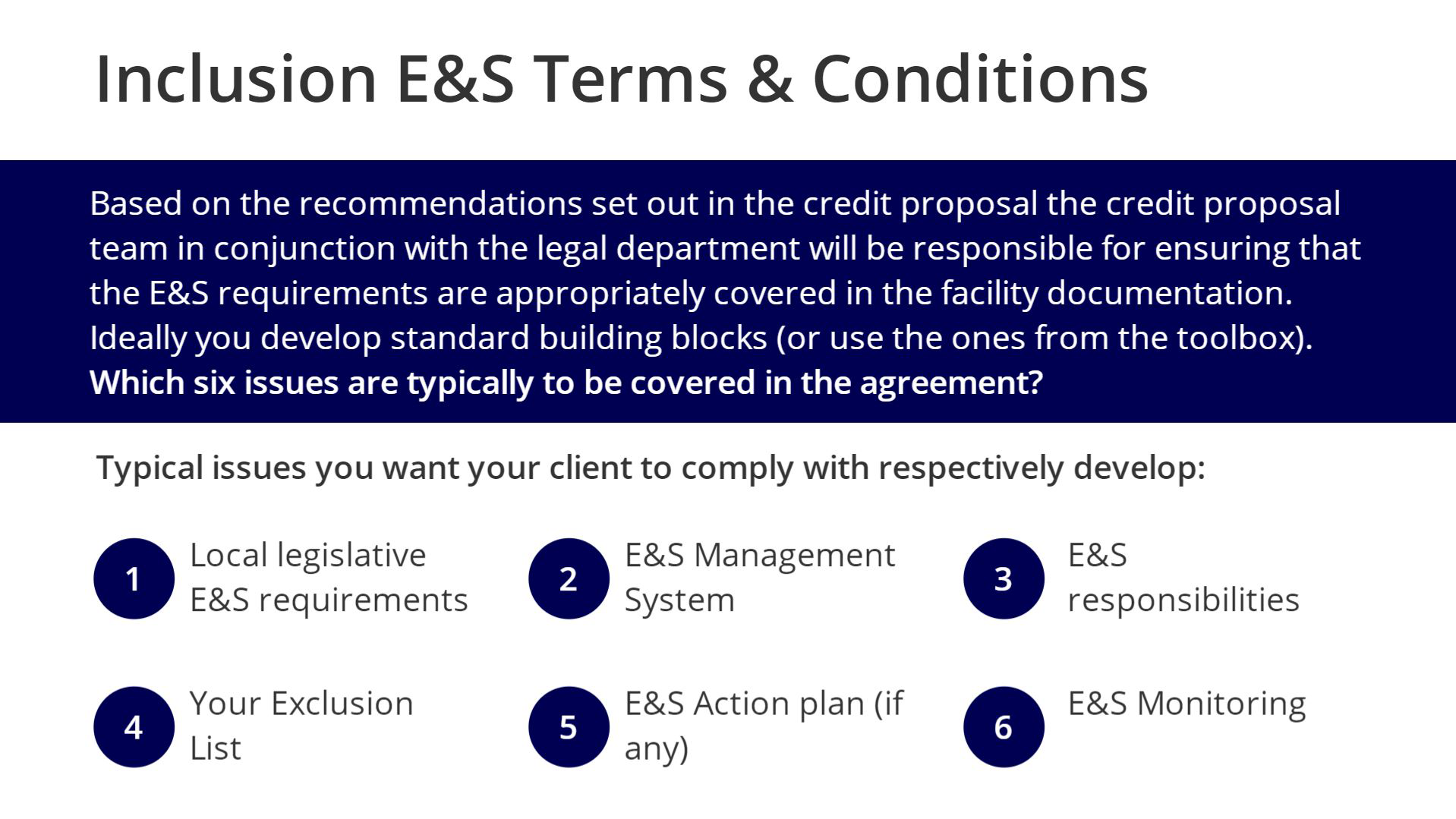
Based on the recommendations set out in the project appraisal report, the RM shall ensure that the E&S requirements are appropriately covered in the loan agreement. This can take the form of
- Necessary Terms and Conditions, clauses to be incorporated in the Legal Contract
- Conditions to be fulfilled prior to disbursements
- Conditions to be fulfilled on best efforts basis
- Status reports to be submitted to the bank by the project proponent / sponsor and the time framework for such reports (Status reports could be at various time intervals or at various milestones of the project)
For category A projects the RM and the ESC have to suggest relevant contract clauses in close cooperation with the legal department, based on a series of pre-formulated building block clauses. In line with your banks Environmental and Social Policy the requirements have to encompass:
- Compliance with Sri Lankan environmental and social legislation
- Compliance with your exclusion list
- Compliance with ILO Conventions ratified by Sri Lanka
- Very often: Compliance with / “aspiration” to IFC Performance Standards
- Preparation of an annual monitoring report in a pre-described format
- Implementation of recommendations from ESIA or ESAP, if relevant
- other clauses, if deemed necessary
For category B and C projects, it is usually sufficient to ask the client to
- Comply with local environmental and social legislation,
- Comply with an ESAP (if necessary),
- Comply with the exclusion list
and to inform your bank in case of relevant serious events. Risks can be considered limited.
In respect of projects of “Category A”, the RM needs to send a copy of the legal contract to ESC for record and monitoring purposes.
Monitoring
 If necessary, predefined action plans, loan covenants and contractual agreements serve as
benchmarks to monitor, evaluate and report on client, project, or supplier performance. Monitoring systems
should also cover relevant media reports, industry developments and news from peer groups to ensure the early
detection of critical situations such as NGO campaigns or shareholder resolutions.
Many banks do the following:
For category C projects no monitoring and reporting is necessary
For category B projects the client has to confirm in writing that he is in compliance with the E&S contractual requirements and – if applicable – prepare an update of the E&S action plan and specific E&S requirements that has been agreed upon.
For category A projects,
- The ESC has to monitor the environmental and social performance of category A projects annually and visit the site occasionally, if necessary. As a rule of thumb: “Category A” projects shall be visited once during the implementation period and every year thereafter, either by the RM or the ESC. Very often it is advised to involve external consultants in the external monitoring
- Additionally, the client company has to report annually by using the specific reporting. The RM is expected to request this information from the client on an annual basis / respectively jointly fill the form during site visits.
- The ESC will prepare an internal annual reporting review per client. (Sample)
The ESC shall report to ESM Manager, on any kind of non-compliance / non-fulfillment. The ESM shall take appropriate remedial action on case-by-case basis. Depending on the seriousness of the violations, he shall report the same to the Credit Committee.