ES Risks
Section of 7
Introduction
Why all this?
Setting up an ESMS
Environmental and Social Policy
ESMS Manual (E&S Procedures)
Manpower - Sufficient inhouse capacity
Relevant E&S Standards
Introduction
An E&S Management System (ESMS) is a system consisting of procedures, management commitment, delineation of roles and responsibilities and guidance that a bank/PE fund follows to review and manage the E&S issues and risks associated with its investments.
The following sub-section of the toolkit describes the different elements of an E&S Management System and provides guidance for your bank in developing these elements (good practice).
|
|
|
|
|
Menu |
|
Toolbox-Link |
|
Document Download |
|
External Link |
|
|
|
|
|
Why all this?
Environmental and social risks related to a client’s business can translate into direct monetary losses for a Financial Institution (FI). FIs thus have not only an ethical but also an economic incentive to fully understand their clients’ E&S performance.
Environmental and social risks related to the financial engagement of a FI can include:
 Direct operational risks leading to potential financial losses;
 Reduced profitability due to higher costs;
 Substantial clean-up costs;
 Delayed construction and completion of projects (disruption of operations &
project delays, compensation claims)
 Penalties / sanctions levied by local authorities;
 Market loss due to boycott of clients;
 Financing
risks (lower willingness of financiers to borrow/fund);
 Reputational risks for both the borrower and potentially the financing FI, such as negative headlines or
even NGO campaigns.
These in turn impact on a client's cash flow and guarantees exposing a Bank risks like
1
Liability for E&S damage caused by client
2
Credit Risks - Reduced repayment capacity of client
3
Collateral/Guarantee Risks - Reduced value of collateral of client
The number of cases in which FIs have either lost money or reputation due to improper E&S performance of their clients is rising sharply and is expected to continue to rise (e.g. driven by social media communication).
It seems that, in the past, FIs needed to experience such problems at least once before E&S risks begun to be perceived as real business risks that must be identified and mitigated like other business risks. At the same time, E&S opportunities usually remain unexploited
This is why banks all over the world have started to set up E&S risk management systems. Please note that the SLBA-SBI course “E&S risk management for FIs” (Module 2) contains important background information on questions around the ESMS and its development.
Setting up an ESMS
Given the very different nature of banks in Sri Lanka, one has to note that there are no “off the shelf solutions” for developing an ESMS. Nevertheless, experiences from numerous banks have shown that the following approach has been found to be very efficient:
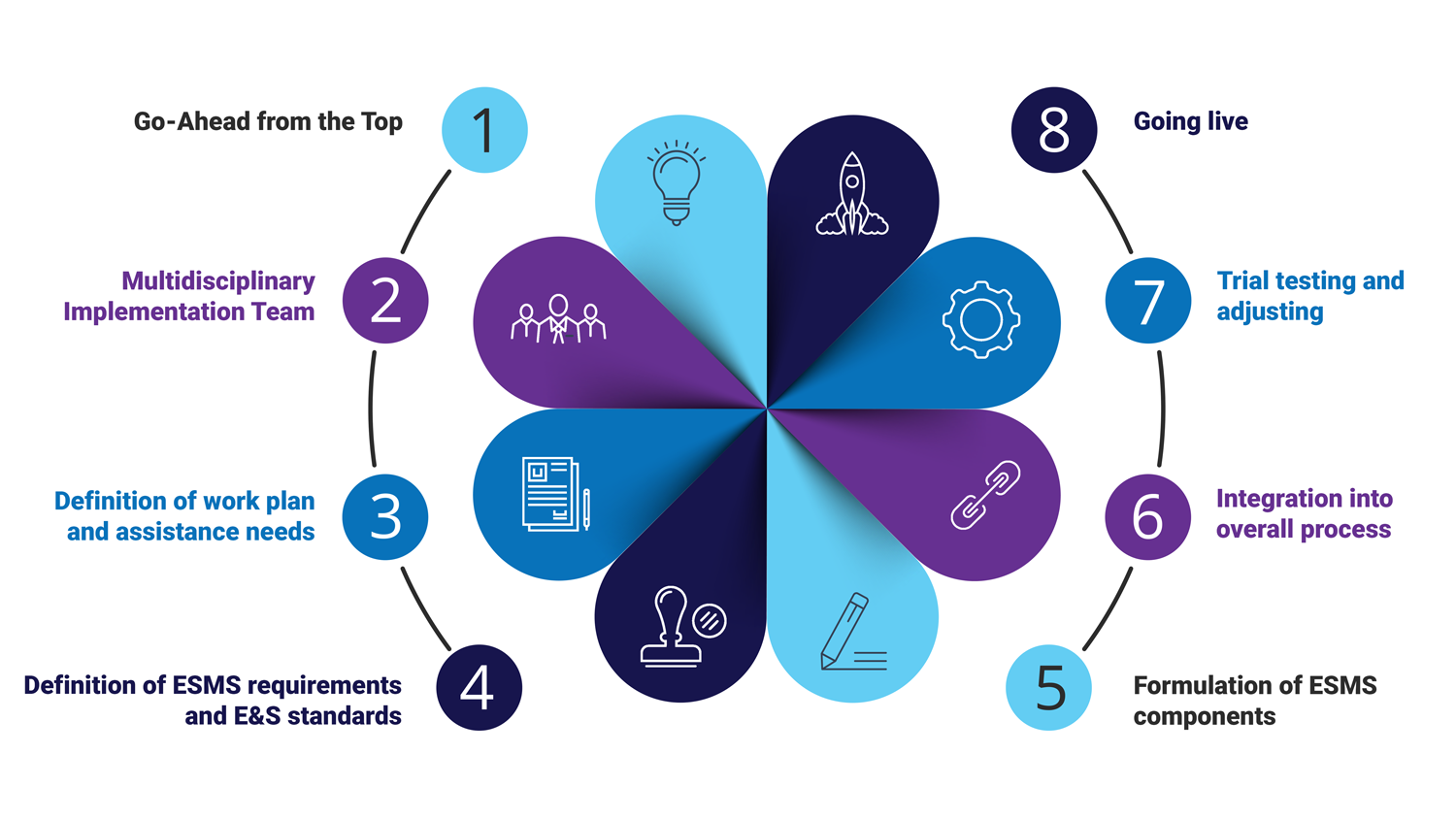
1  Go-Ahead from the Top

Developing an ESMS will not work if it is not supported by senior management from day 1.
It is therefore of key importance that the senior management is well informed about the latest good international practices in sustainable banking in general and in environmental and social management in the banking sector in particular.
A very efficient way to inform CEOs accordingly is through UNEP-FI publications. Please note that they also have a series of CEO briefing papers.
Specifically designed for this purpose, obviously, it the E-Learning Module 6 of this platform “CEO Brief”, which provides senior manager as well as CEOs with a concise introduction into the usefulness of E&S management.
Please note that majority of Sri Lankan banks have signed up to the SLBA-SBP including the Principle 1:
 Our Business Activities: Environmental and Social Risk
Management: We will integrate environmental and social considerations into decision-making
processes relating to our Business Activities to avoid, minimize or offset negative
impacts.
Most SL banks have endorsed the SBP Implementation Guide which requires the banks to set up an E&S Management system.
Please also note that just a “go ahead” may not be sufficient if this is not supported by necessary resources (mainly manpower) to meaningfully set up an ESMS.
2  Multidisciplinary
implementation team

Key staff involved with the ESMS implementation in the Banks are in particular Head of Risk/Credit Risk/Corporate Banking/Credit Administration, Relationship Managers, Credit Analysts, E&S Manager, E&S Officer/Coordinator as well as internal training functions.

It has been shown that it is crucial to establish a Working Group comprising delegates from these different functions to get a common understanding of the implications and a buy-in from the very beginning.
It probably makes sense that the members of the working group undergo the E-Learning Module 2 (E&S risk management) to get a better picture of the work ahead and why this is useful.
Ideally, the bank nominates already an E&S coordinator (referred to in this toolbox as ESC) who will act as a contact person for E&S risk management issues in the day to day work and takes the lead in setting up the ESMS. He is usually supported by an E&S Manager (i.e. a senior manager) who assures that the ESC can perform his work.
3  Definition of work plan
and assistance needs

Once the working group has been setup, it is important to jointly develop and agree upon a detailed and workable draft action plan for the implementation of the ESMS. This action plan will pinpoint all necessary steps the bank should undertake in order to develop from the scratch or improve its existing ESMS and finalize its implementation across the bank.
Despite the information readily available on the internet, acknowledging the fact that one does not necessarily need to reinvent the wheel and despite this toolbox which is specifically meant to assist in developing an ESMS, it is possible that certain tasks cannot be performed by the banking staff or ESC.
Therefore, the bank may need to consider the outsourcing of certain workpackages to specialised consultants (e.g. training, adaptation of procedures, …). This will need to be incorporated into the work plan.
 It is of great importance that the action plan will not only be agreed upon
by the top management, but also all necessary resources (mainly human resources, top management
time, a certain budget) will be allocated.
This action plan will describe all the necessary steps in detail, define responsibilities, formulate necessary resources per action and set a time frame.
It can be very useful to agree upon a set of key performance indicators (KPI), i.e. number of quantifiably targets that should be achieved in a given time frame. An example for such a list of KPI prepared by DEG can be found here.
A sample for such a work plan can be found here.
The sample already shows that we rather talk about months or even years than weeks to set up an ESMS.
4  Definition of ESMS requirements and
underlying E&S standards

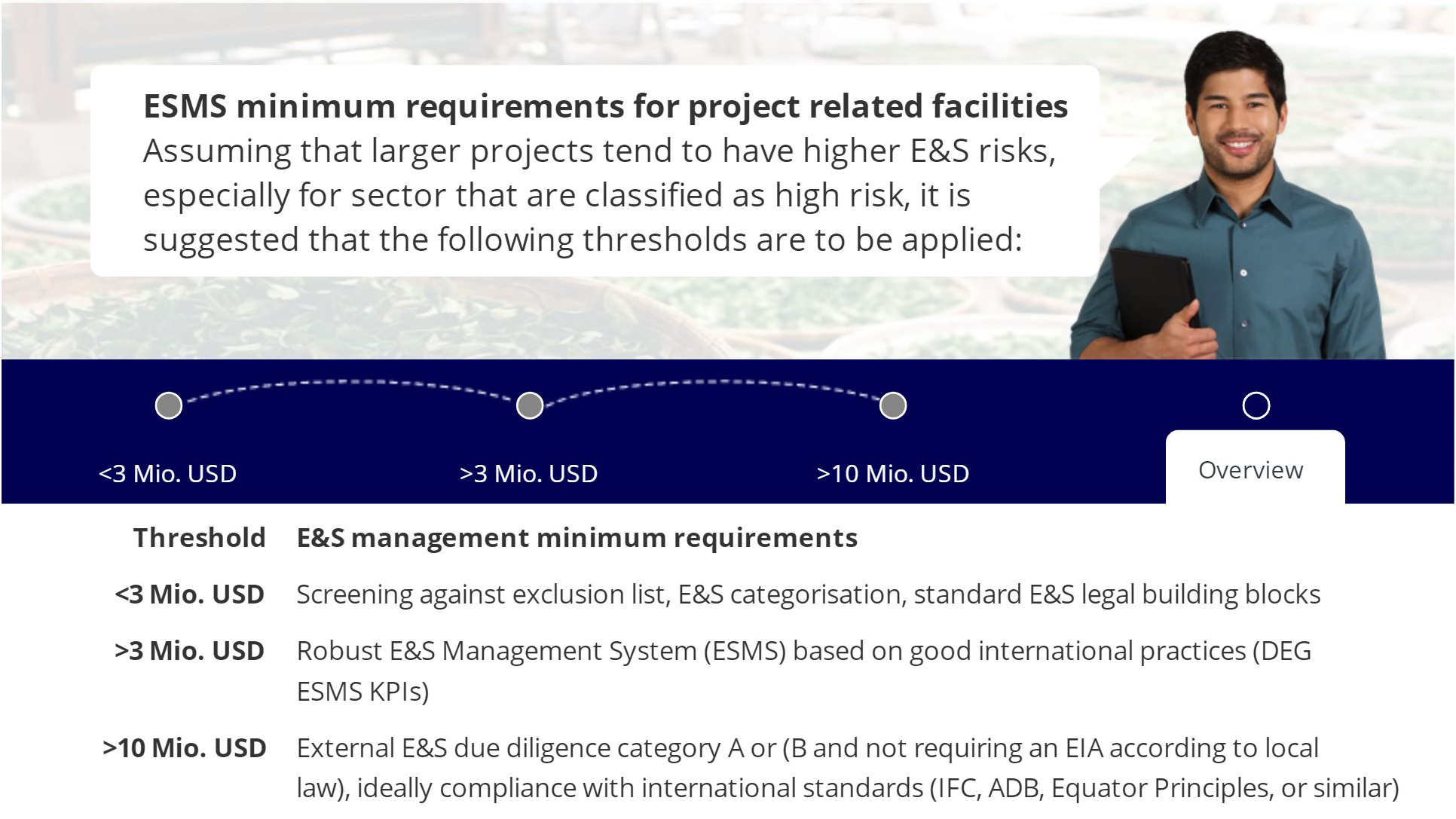
The ESMS needs to be “risk adequate”, i.e. proportionate to the types and magnitude of E&S risks that your bank is likely to encounter in its investments. It further needs to include the requirements from various actors (e.g CBSL) and commitments signed (e.g. voluntary commitments like SLBA SBP, agreements with other stakeholders / investors).
An increasing number of banks subscribe to the IFC Performance Standards or other E&S banking standards. This would need to be reflected in the ESMS.
The requirements for an ESMS coming from the SLBA SBP can be summarised as follows.
5  Formulation of ESMS
components

As described in this toolbox, an ESMS primarily includes a policy, a set of procedures to identify, assess and manage environmental and social risks in financial transactions and internal capacity of staff responsible for environmental and social management and investments.
In accordance with the work plan that had been developed earlier, the different ESMS components need to be developed, either from the scratch or based on the existing. See toolbox below for further guidance.
Some guidance can be taken from sample ESMS documentation (IFC, EBRD)
6  Integration into overall
process / training

E&S procedures need to be integrated with the financial institution’s existing risk management framework and are ideally part of the Credit or other Operational procedures of the bank. This clearly means that ideally, the credit procedures are updated.

As part of the integration, procedures need to be communicated to ensure that all existing and new staff are aware of the process.
The training course should focus mostly on the E&S procedures as well as on the underlying E&S standards (e.g. new IFC Performance Standards or SLBA SBP) and how they relate to the banks activities.
Again, it probably makes sense that all related staff undergoes the E-Learning Module 2 (E&S risk management) to get a better understanding about the necessity for such a system. Other E-Learning courses offered by the SLBA-SBI will complement the picture.
7  Trial testing and
adjusting

Once the staff is well trained and the procedures are precisely formulated, accepted and understood, the ESMS is typically ready for a trial testing process. This phase may take some 2-4 months and the idea is to test the ESMS on a selected number of transactions before rolling out the ESMS to the entire operations of the bank.
Improvements and changes proposed to the existing policies, procedures, tools, guidelines and other material prepared will need to be discussed in detail in the implementation team, if necessary.
This phase could comprise an evaluation of the application of the ESMS during the trial testing phase plus of the overall ESMS implementation status, i.e. whether the work plan has been completed.
FI normally would have applied the ESMS in at least one real potential category A case (high E&S risks) or a category B project with specific high risk elements.
The evaluation can be done with the help of the agreed KPI list. Usually, a summary report indicating any challenges, results achieved, gap analysis, necessary future steps is prepared for the senior management after the evaluation.
8  Going live / monitoring of implementation

Once the trial phase has successfully been completed, it is ready to go live. The going live is normally announced by the senior management.
Please also visit First for Sustainability for further guidance.
Environmental and Social Policy
ESMS Manual (E&S Procedures)
Manpower - Sufficient inhouse capacity
Relevant E&S Standards
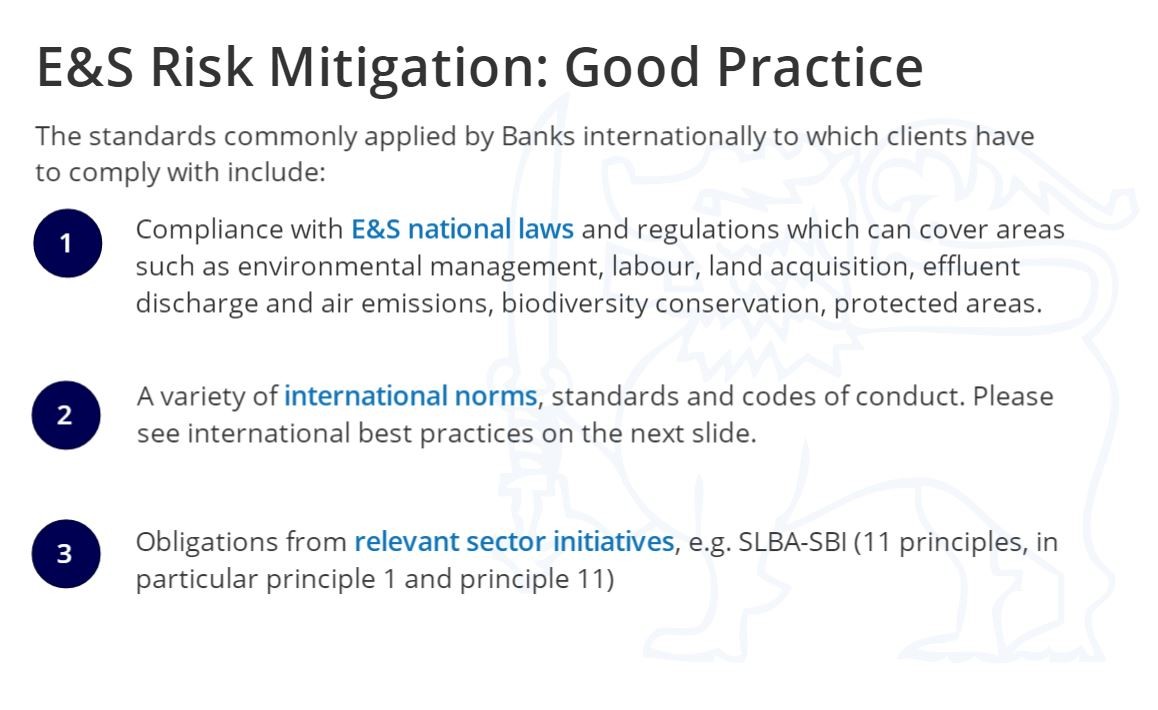
E-Learning Module 2 provides for details to all these standards.
Most relevant E&S risk management standards for banks are the internationally recognised IFC Performance Standards.
The full IFC Performance Standards can be downloaded here.
Rather than going through the entire Performance Standards (50 pages) and the accompanying Guidance Notes (273 pages) which intend to Guide the user of the Standards through their implementation, it could make sense to get a list of relevant questions that you would need to address with your client:
8 IFC Performance Standards
- Performance Standard 1: Assessment and Management of Environmental and Social Risks and Impacts
- Performance Standard 2: Labor and Working Conditions
- Performance Standard 3: Resource Efficiency and Pollution Prevention
- Performance Standard 4: Community Health, Safety, and Security
- Performance Standard 5: Land Acquisition and Involuntary Resettlement
- Performance Standard 6: Biodiversity Conservation and Sustainable Management of Living Natural Resources
- Performance Standard 7: Indigenous Peoples
- Performance Standard 8: Cultural Heritage